
Articles
How Plants Live: Water Transport
Author: Fidelia Sihombing | Publication Date: 24 February 2026
Water transport in plants is defined as the unidirectional movement of water and dissolved minerals (xylem sap) from the soil to the roots, up the stem, and finally to the leaves and other upper parts of the plant. This process is crucial for replacing water lost during photosynthesis and transpiration, maintaining cell turgor pressure, and distributing nutrients obtained from the soil throughout the plant.
In the previous article, we discussed water absorption. In this article, we will discuss the transport of water and dissolved nutrients from the roots to the rest of the plant.
Why is water and solute transport in plants important?
The effective transport of water and these substances from the soil is crucial for plant health, growth, and response to the environment.
- Water. In addition to hydration, water is a key ingredient in photosynthesis and acts as a solvent for metabolic products. Water maintains turgor pressure, which supports and holds plants upright, and regulates leaf temperature through evaporation.
- Nutrients. Plants require 17 essential nutrients to complete their life cycle. These nutrients range from macronutrients, such as nitrogen and phosphorus, which are essential for protein synthesis, to micronutrients, such as iron and zinc, which are required for enzyme activation. Deficiencies in these nutrients disrupt physiological processes, leading to stunted growth, chlorosis, and even death.
- Hormone. Hormones act as chemical messengers, transported through the vascular system, to regulate growth and development. For example, the hormone abscisic acid (ABA) is translocated in response to water shortages, signaling stomata to close and preventing further water loss.
- Photosynthate. Sugars produced in leaves serve as the primary energy source for growth and metabolism. Photosynthate is transported to meristem tissue that is still actively growing or to storage organs, such as roots and tubers. This photosynthesis is used by plants during dormancy.
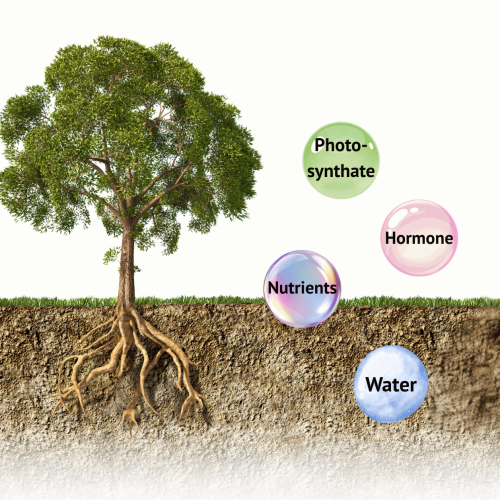
Figure 1. Water and dissolved substances absorbed and transported by plants
In the context of global climate change, with increasing frequency of droughts, heat waves, and land degradation, understanding water transport mechanisms is becoming increasingly relevant. PEFORDEI Research views water transport as a key link between plant physiology and environmental dynamics. Through a science-based approach, PEFORDEI Research focuses on understanding the fundamental mechanisms of water transport and their implications for plant resilience and ecosystem sustainability.
Xylem: The Primary Water Transport Tissue
Xylem is a complex vascular tissue responsible for transporting water and dissolved minerals from the roots to other parts of the plant, while also providing mechanical support that allows plants to grow upright and reach a certain height.
Xylem Anatomy: Conducting and Supporting Cells
Xylem is composed of various specialized types, mostly dead cells that have been strengthened to withstand internal pressure.
- Tracheids are long, slender cells with tapered ends found in all vascular plants. These cells form hollow channels that allow water to move vertically and laterally through pits, which are areas in the secondary cell walls that lack lignification.
- Vessel elements, commonly found in flowering plants (angiosperms), are shorter and wider than tracheids. These cells are arranged end-to-end, forming continuous vessels with relatively low flow resistance, thus increasing the efficiency of water transport.
- Supporting Cells:
- Xylem fibers, which are strong, elongated cells with woody cell walls, provide mechanical strength to the plant.
- Xylem parenchyma, the only living cells within the xylem tissue, are involved in storage, metabolic activity, and lateral transport of water and nutrients.
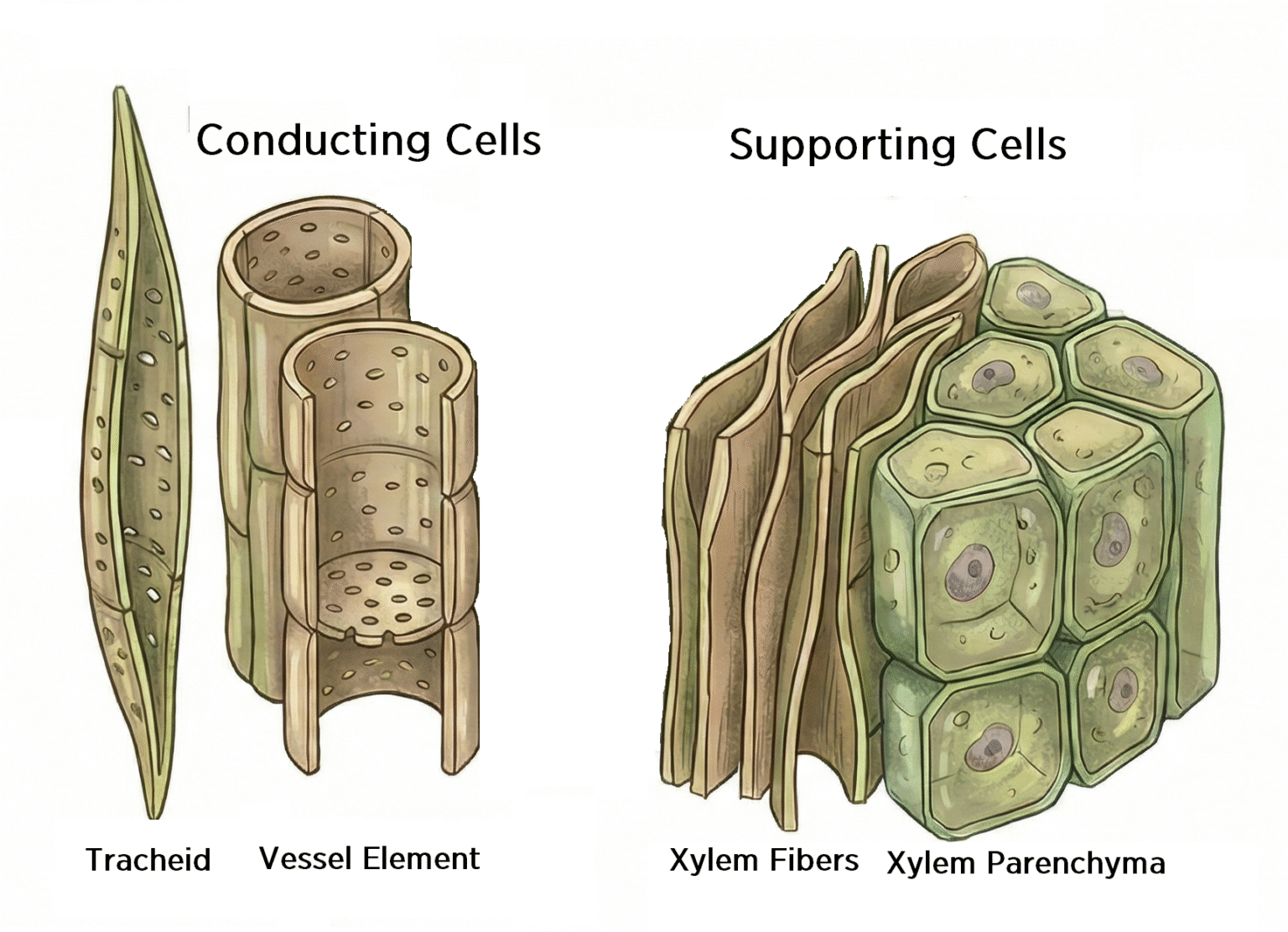
Figure 2. Xylem Elements
Xylem Sap Composition
Xylem sap is a water-based solution that serves as a medium for distributing essential resources absorbed from the soil. Its main components include:
- Water: The solvent for all transported materials.
- Mineral Ions: Essential inorganic nutrients such as nitrogen (nitrate/ammonium), phosphorus, potassium, and various micronutrients.
- Hormone: Xylem acts as a conduit for water-soluble growth factors and hormones (such as abscisic acid) that regulate plant development and responses to environmental stress.
How can water move upwards? Cohesion–Tension Theory
The movement of xylem sap against gravity is a passive process explained by the cohesion–tension theory. This mechanism relies entirely on physical forces and does not require metabolic energy.
This process begins with transpiration in leaves, when water evaporates from the mesophyll cell walls and exits through the stomata. This evaporation creates a very strong negative pressure in the leaf tissue, reaching approximately -2 megapascals (-2 MPa). This pressure then pulls the water column upward from the roots through the stem.
Water movement follows a water potential gradient, from the higher water potential in the soil to the increasingly negative water potential of the plant tissue, up to the atmosphere.
The water column’s stability is maintained by two primary physical properties of water: cohesion and adhesion. Cohesion, generated by hydrogen bonds between water molecules, provides the water column with internal tensile strength. Adhesion, the ability of water molecules to adhere to the hydrophilic xylem cell walls, helps support the water column and prevent it from being dislodged by gravity.
The lignified walls of the xylem prevent the collapse of the transport vessels under extreme negative pressure, allowing for the continuous flow of water.
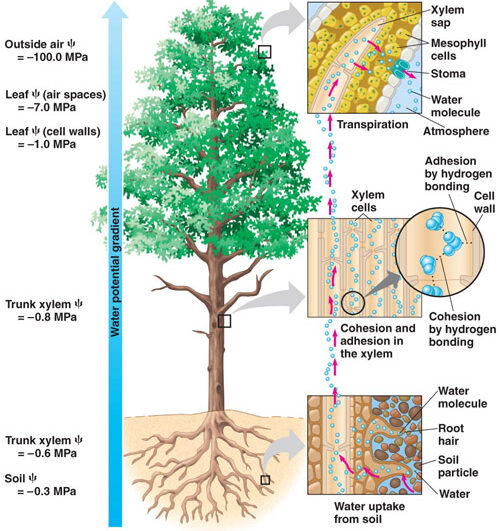
Figure 3. Water Movement
Cavitation and Embolism
Under extremely high-pressure conditions, such as during extreme drought, the water column can be disrupted through cavitation. This process results in the formation of emboli, gas bubbles that block water flow. However, many plants have structural and physiological mechanisms to limit the spread of embolisms and, under certain conditions, refill blocked vessels.
Experimental Evidence for Water Transport
The cohesion–tension theory is supported by a variety of experimental evidence. One example is the observation of a decrease in tree trunk diameter during the day when transpiration peaks, reflecting the high tension in the water column within the xylem.
Classic experiments by Dixon and Joly also demonstrated that toxic solutions can be drawn to the tops of cut trees, demonstrating that leaves, through transpiration, are the primary drivers of upward water transport
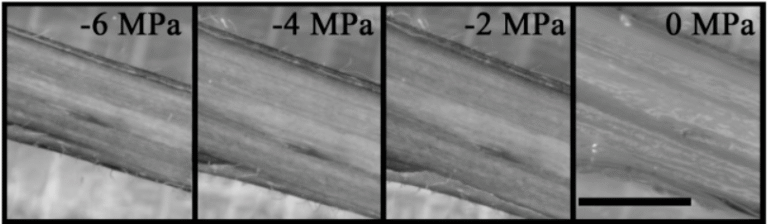
Figure 4. Stem diameter and xylem emboli at various water pressures (source: doi: 10.1104/pp.20.00897)
Factors Affecting Water and Dissolved Mineral Transport (Xylem)
The transport of water and dissolved minerals to the upper parts of the plant is essentially a passive process driven by the cohesion-tension theory, which relies on a continuous water column and evaporation from the leaves.
- Transpiration. Factors that increase transpiration, such as high temperature, low humidity, and wind, will accelerate the upward movement of water. Conversely, high relative humidity or increased CO2 can reduce stomatal opening, slowing transpiration.
- Vascular Integrity and Stress. Extreme drought can create excessive tension, leading to cavitation and embolism formation, thus impeding flow.
- Nutrient Availability. Potassium (K) is essential for regulating stomatal opening and closing, which drives transpiration. Calcium (Ca) influences water movement within cells and helps maintain cell wall structure, while copper (Cu) and lignin synthesis ensure the structural integrity of xylem vessels, preventing them from collapsing under pressure.
- Root and Soil Health. Water transport is limited by the surface area of root hairs and the efficiency of roots in absorbing water from the soil. High soil salinity lowers water potential, making iast difficult for roots to absorb water.

Figure 5. Acacia tree on a dry grass field
Conclusion
Water transport in plants is a passive yet highly integrated process that enables the movement of water and dissolved minerals against gravity through the xylem tissue. Through a cohesion-tension mechanism driven by transpiration, plants maintain a continuous water column from roots to leaves without requiring metabolic energy.
The specialized structure of the xylem balances transport efficiency and hydraulic safety, though the system remains vulnerable to environmental disturbances such as drought and extreme temperatures. Understanding water transport is important not only in the context of plant physiology but also as a basis for assessing plant resilience, ecosystem management, and environmental sustainability amid global climate change.

Figure 6. PEFORDEI Research Logo
Bibliography
17 Essential Plant Nutrients and Their Functions | Haifa Group. (n.d.). Retrieved February 24, 2026, from https://www.haifa-group.com/articles/main-functions-plant-nutrients
25.4B: Vascular Tissue- Xylem and Phloem. (2018, July 16). Biology LibreTexts. https://bio.libretexts.org/Bookshelves/Introductory_and_General_Biology/General_Biology_(Boundless)/25%3A_Seedless_Plants/25.04%3A_Seedless_Vascular_Plants/25.4B%3A_Vascular_Tissue-_Xylem_and_Phloem
Qaderi, M. M., Martel, A. B., & Dixon, S. L. (2019). Environmental Factors Influence Plant Vascular System and Water Regulation. Plants, 8(3), 65. https://doi.org/10.3390/plants8030065
Rockwell, F., & Sage, R. F. (2022). Plants and water: The search for a comprehensive understanding. Annals of Botany, 130(3), i–viii. https://doi.org/10.1093/aob/mcac107
Skelton, R. (2020). Stem Diameter Fluctuations Provide a New Window into Plant Water Status and Function1. Plant Physiology, 183(4), 1414–1415. https://doi.org/10.1104/pp.20.00897
Let’s Advance Plant Science Together
From research collaborations to training and consultation, we’re here to connect knowledge with impact. Join us in exploring the hidden power of plants for health and sustainability..